It ends at the eave
Stain only in a thaw? Check the eave before you buy a roof
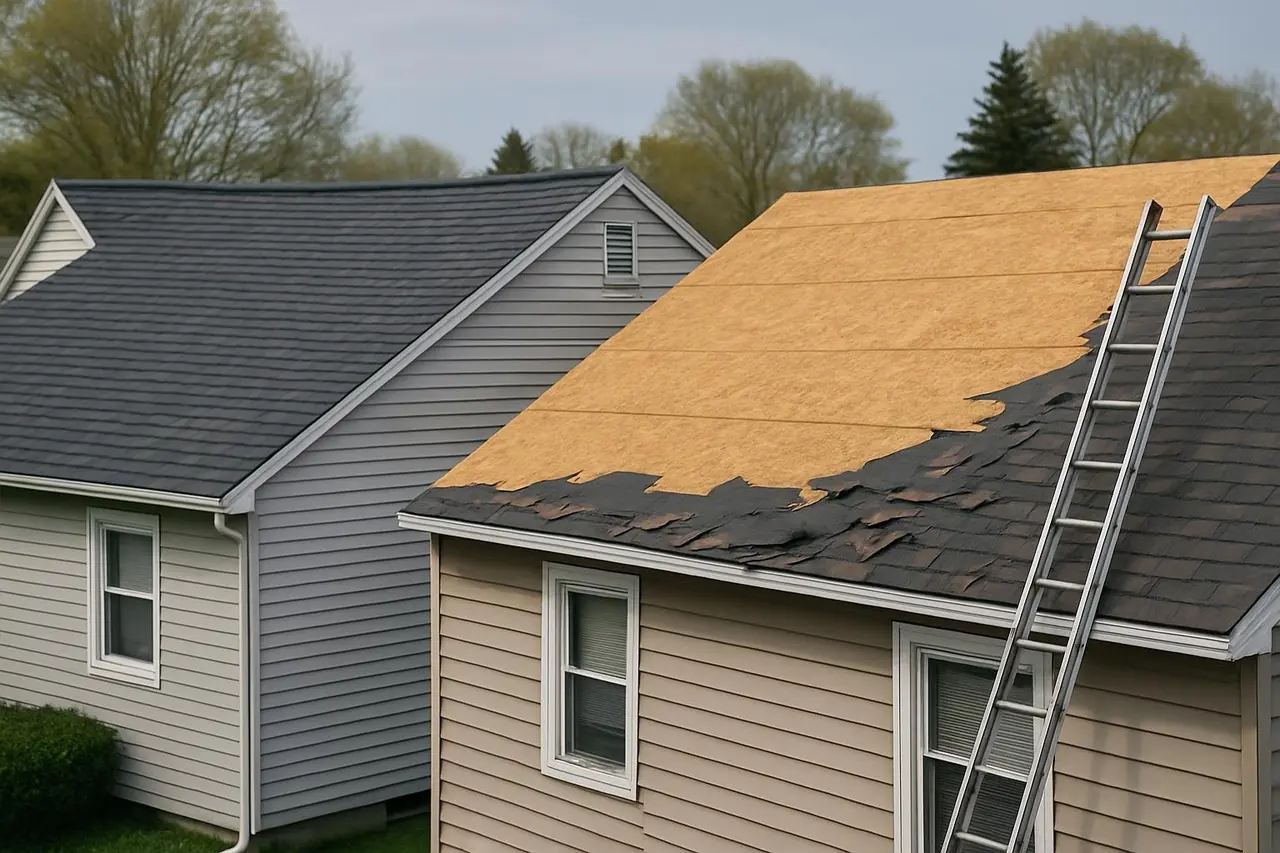
In Syracuse and the towns around it, icicles outside and a ceiling stain that comes and goes with the weather do not always mean a new roof. Say what your roof is doing and when you notice it. We arrange for an independent roofer to come and look, and to write up the work they would do. You compare it line by line, then decide.
What we do
Describe the roof in a few lines, and an independent roofing contractor comes out to look at it, then prices the work for you in writing.
What we promise while you decide
- No charge from us, whether you book or not.
- The roofer's price comes to you on paper first.
- You may ask for a repair price beside the replacement one.
- Credit terms are spelled out on our Terms page.
Workmanship and contract terms belong to the roofer you hire.
Signed Roof Replacement Syracuse, (315) 640-3590
Read the full termsThe edge
Why your roof gives out at the edge first
Snow does not melt evenly across a roof, and the place where the melting stops is where the trouble starts.
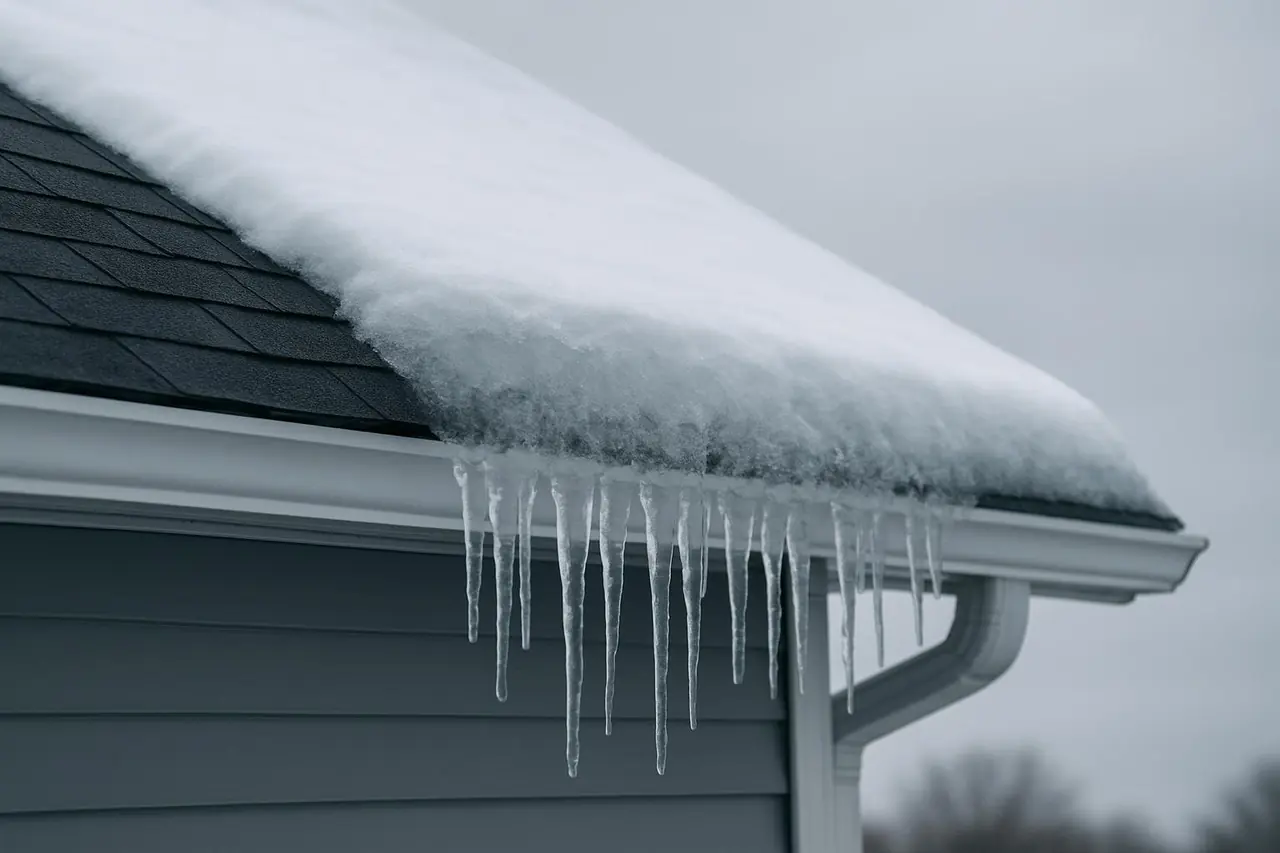
The upper slope sits over a heated house, so snow on it can melt on a day that never leaves freezing. The water runs down until it reaches the overhang. The overhang is outdoors and cold, so the water freezes there, and the ridge of ice holds back the next melt. With nowhere to go, the water works its way under the shingles.
That is why a stain along an outside wall, with icicles hanging outside it, makes the eave the first place to look. It also means the shingles you see from the street are not the whole story. Study the drawing, then ask any roofer who gives you an estimate what they plan to put at the edge.
The eave, drawn
Follow the water to the edge
Trace a thaw from the warm wall to the cold edge. Then ask which of these parts your estimate covers.
- 1
Shingles
Freeze-thaw cycles wear on asphalt shingles, along with sun, heat and wind.
- 2
Warm wall
Heat from the house can warm the deck above the wall.
- 3
Cold overhang
The overhang sits outdoors, so melted snow refreezes there.
- 4
Meltwater
Here the roof crosses freezing on roughly 84 days a year.
- 5
Ice dam
A ridge of ice builds at the edge and holds back the melt.
- 6
Backup
Held water backs up under the roofing and can reach the deck.
- 7
Ice barrier
The ice barrier reaches 24 inches inside the wall line.
- 8
Drip edge
A metal drip edge carries water off past the deck.
- 9
Deck
The deck is the wood under it all, and tear-off shows it.
Questions
Questions before you ask for a visit
My ceiling stains only when snow melts. Do I need a new roof?
Not necessarily. A stain that shows only in a thaw often points at the eave, where melted snow refreezes and backs up. Ask the roofer whether the problem is the edge or the whole roof, and ask for the repair price beside any replacement price.
Can a roofer lay new shingles over the old ones?
Sometimes, but not over two or more layers, and not over a roof that is soaked or has deteriorated. Ask whether the price you were given includes tear-off to the deck. If it does not, you are comparing two different jobs.
Can I look up a roofing license in Onondaga County?
No. New York issues no state roofing license, and the county runs no licensing program of its own. What you can check is public: the state's workers' compensation coverage search, a written contract, the three business day cancel notice, and where your deposit is held.
Who is Roof Replacement Syracuse, and who is the roofer?
We help you decide between a repair and a replacement and book a visit from an independent roofing contractor. The roofer looks at the roof, writes the estimate and does the work if you choose them. We are not the roofer and we do not write the estimate.
Will my homeowner's insurance pay for a new roof?
Only your own policy can say, and the answer turns on the cause of the damage. The state's consumer guide explains actual cash value, replacement cost and depreciation. Read your policy and ask your insurer; we never handle a claim.
Does a new roof on my house need a permit?
It depends on where you live, because the permit comes from your city, town or village and never from the county. Some places name roofing outright and some do not. Ask your local office before the work starts.
What should I do after a storm?
Stay off the roof and look from the ground. Photograph shingles in the yard, any limb and any new stain inside, and write down the date. Then ask a roofer what the storm actually did before you decide what to buy.
When it shows
It may only need the eave, not the whole roof
The date a stain first appeared tells a roofer more than the year your shingles went on.
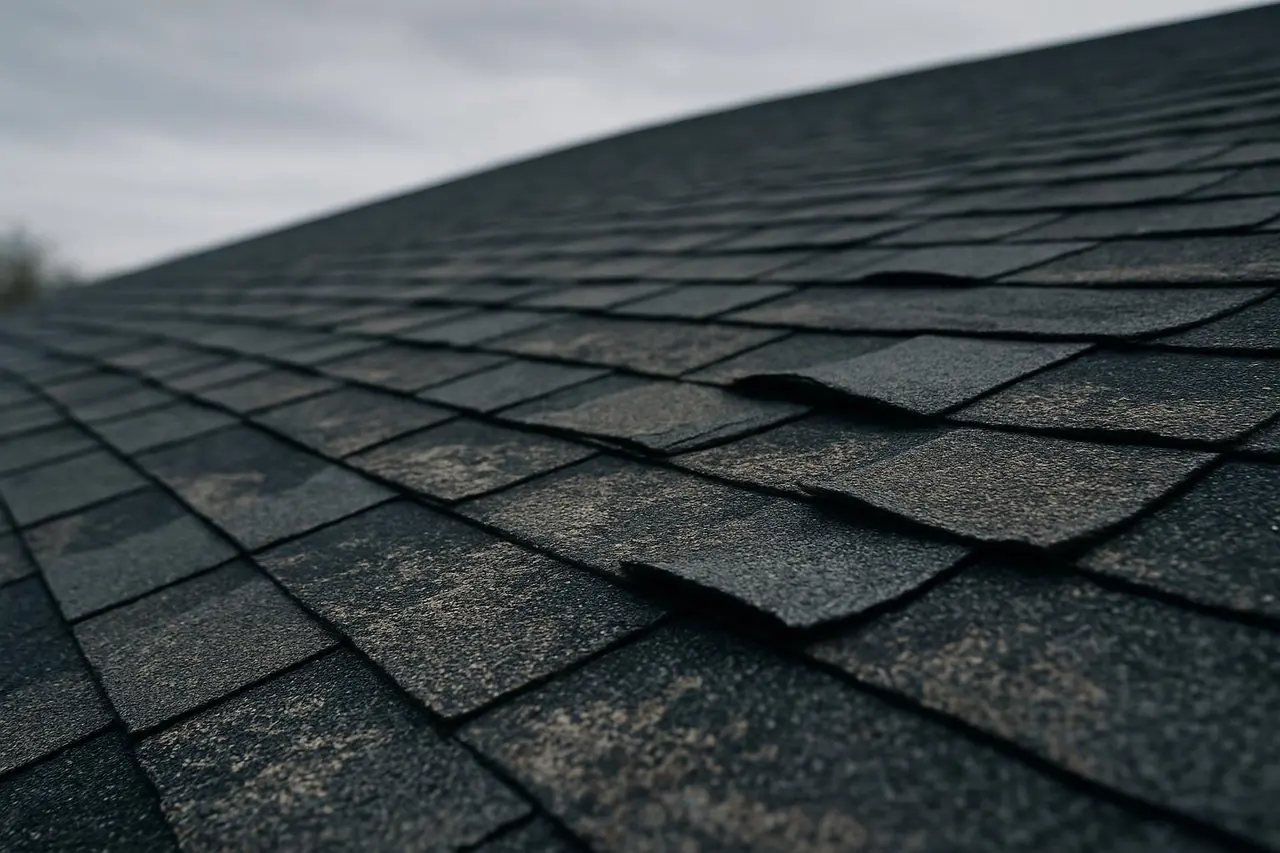
Think back to when you first saw it. A stain that appears only while snow is melting is a different problem from one that shows in every rain, and both differ from a roof that has never leaked but is getting old. The four panels below sort them, and each one says what to check from the ground and what to ask.
Sometimes the honest answer is that most of the roof is sound and only the first few feet at the edge need work. Sometimes it is not, and then the estimate should say why. Either way, ask the roofer to put the repair price beside the replacement price before you agree to the bigger job.
The decision
When does it show?
The timing of a stain tells a roofer more than the age of the shingles.
Only in a thaw
A stain that shows while snow melts often points at the eave first. The roofer confirms it.
Check firstNote which wall edge stains, and the dates.
AskIs this the eave only, or the whole roof?
In every rain
Say so when you book, so the repair is priced for the right spot. Cracked or missing shingles you can see from the yard are what the repair page covers.
Check firstNote whether it grows only after hard rain.
AskWhat did you find, and where?
After a wind or storm
Lifted, creased or missing shingles point to storm damage. That can be a section, not a roof.
Check firstScan from the yard for shingles on the ground.
AskIs this a section repair or a full slope?
No leak, old roof
Age alone does not decide the job. The federal table lists asphalt shingles at 20 years, as a planning number.
Check firstLook for bare patches and curled tabs from the ground.
AskWhat would tell you this roof has years left?
Under the shingles
What a real tear-off takes down
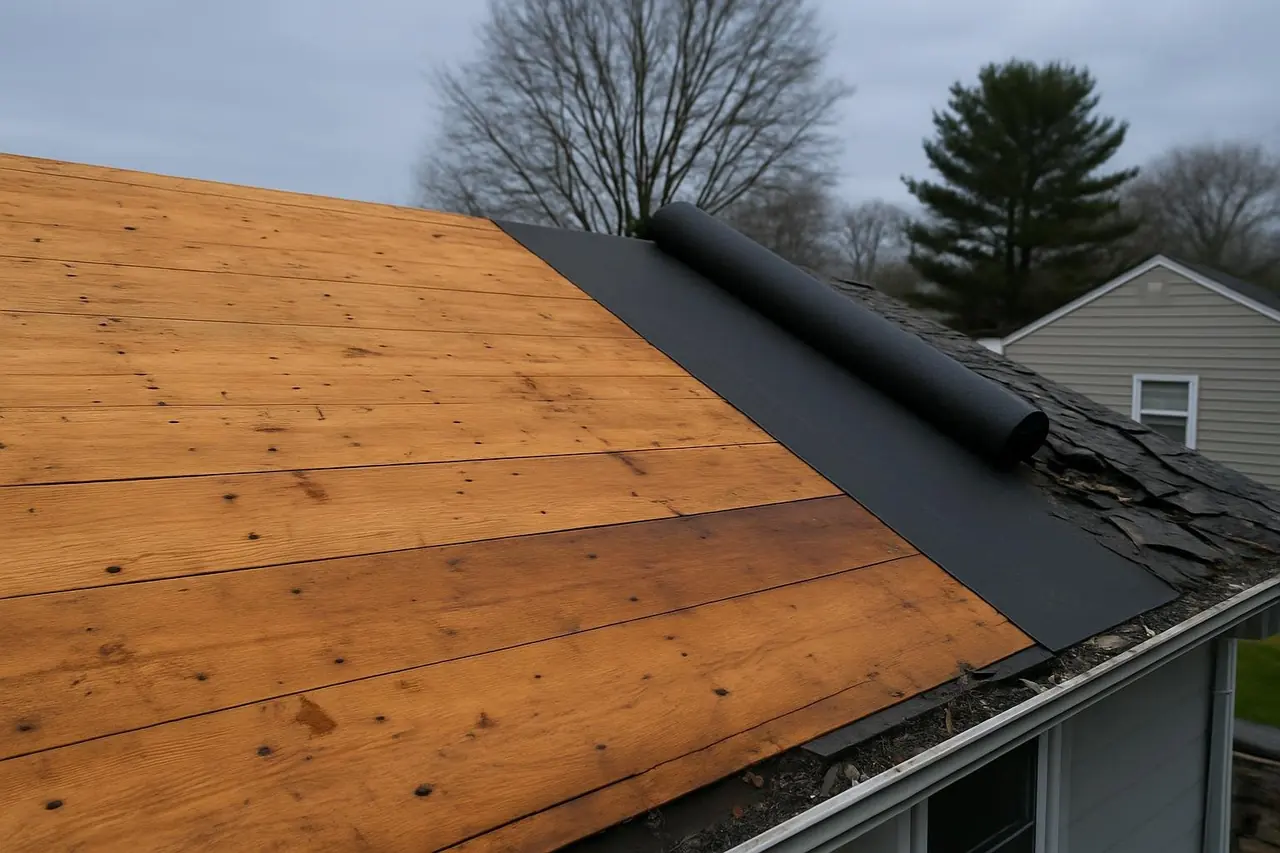
A replacement strips the old roof to bare wood, and that is the one day anyone sees the whole deck.
Tear-off is also the day a roofer learns whether the boards at your eave are sound. The code does not allow a new roof over two or more layers, or over a roof that is soaked or has deteriorated. So a low price can hide what it leaves out.
Check whether each estimate names the tear-off, the bad deck wood, the ice barrier and the drip edge. If a line is missing, ask what it would add to the price if it turned out to be needed later.
The layers
What comes off, and what goes on
Read the stack from the top. Each layer is a line your written estimate should name.
Shingles
These are the layer you see from the street.
A second layer
Two or more coverings rule out putting a third on top.
Underlayment
This sheet sits between the shingles and the deck.
Ice barrier
At the eave it goes down first, 24 inches inside the wall.
Deck
Soft wood cannot hold a nail. A soaked roof cannot be covered over.
Drip edge
Metal at the eave sends water off past the deck.
Two estimates
Why two estimates can look alike and still differ
A gap between two prices is often a line that only one estimate carries.
Set the two estimates side by side and go down the nine checks below, one row at a time. Where one names a line and the other says nothing, the silent one may be less work, not a better deal. Ask that roofer to add the line and re-price it in writing.
The last four rows are paperwork, not roofing. New York issues no state roofing license and the county runs no program of its own, so the coverage record, the written contract and the cancel notice are what you can verify yourself.
Line by line
Two estimates, line by line
Hold both estimates beside this list. Tick each line you can find in each one.
Tear-off to the deck
Says all old layers come off, down to the deck.
Silence about layers can mean shingles laid over old ones. The code defines a replacement as removal to the deck. A missing line changes the work, and so the price.
Bad deck wood
Prices bad decking by the sheet or board.
Nobody sees the deck until the old roof is off. Without a unit price, bad wood becomes an argument after the roof is open.
Ice barrier
Names an ice barrier at the eaves.
The code asks for one where ice forms along the eaves. A quote without it may simply be doing less.
Drip edge
Lists drip edge at the eaves.
It is a small line that is easy to leave off. Ask for it by name so both prices include it.
Worn flashing
Says worn flashing is replaced, not reused.
The code says rusted or damaged flashing is replaced. If one quote reuses it, the two are not the same job.
Permit
Says who pulls the permit, if one applies.
Permits come from your city, town or village, never the county. Ask which office applies at your address.
Workers' comp
Gives a workers' compensation coverage record.
There is no state roofing license or county register. The state's public coverage search is a check you can run yourself.
Written contract
Comes as a signed written contract.
New York requires one in plain English for roofing work. Ask where a deposit is held before you pay.
Cancel notice
Shows a three business day cancel notice.
The contract must tell you about the right to cancel. If the notice is missing, ask for a corrected contract.
After a storm
What did the wind or the ice actually do?
Shingles in the yard are not the same thing as a failed roof.
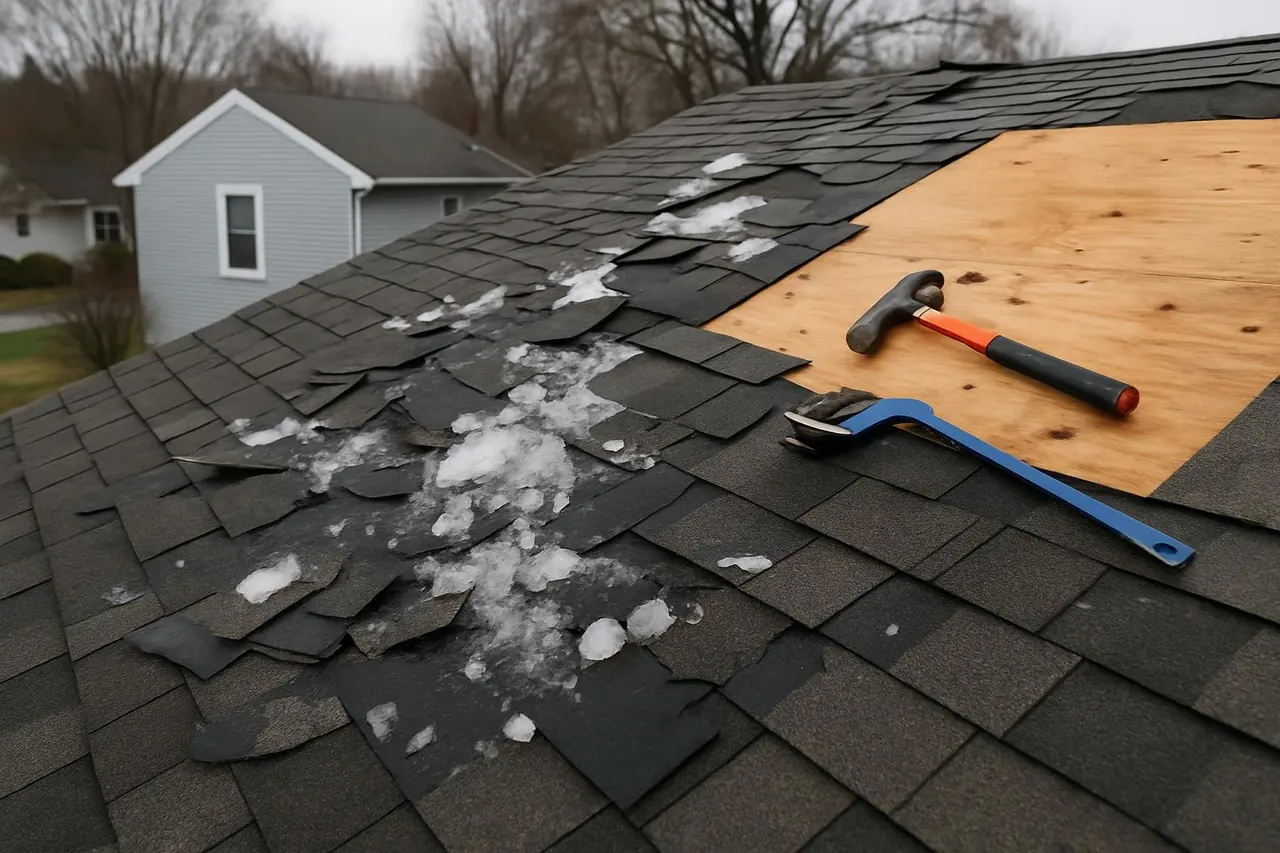
A few lost tabs, a limb mark and a torn slope are three different jobs, and only one of them is a new roof. Photograph the damage from the ground before anything is moved, and write down the date.
Before you call your insurer, read your own policy. Our insurance guide shows how actual cash value and replacement cost differ. We never handle a claim.
The storm sorter
What did the storm do?
Sort what you see, then ask the one question beside it.
Wind
PhotographEach slope and the yard, from the ground.
AskIs this a section repair or a new slope?
Hail
PhotographDents on metal, bruised tabs, any hailstones.
AskWhat do you see on each slope, in writing?
Ice storm
PhotographThe eave edge and any broken limbs.
AskDid the ice hurt the eave detail or only the shingles?
Limb on the roof
PhotographThe limb, and the spot under it.
AskWhat is under the spot where it landed?
Four jobs
Which of these four jobs looks like yours?
Each page covers one kind of roof work, with the questions to ask a roofer about it.
Roof Replacement
Tear-off, deck wood and eave lines to look for
Roof Repair
A section repair, priced before a replacement
Storm Damage Roofing
What the storm did, before you buy more roof
Ice Dam Roofing
The eave detail that decides an ice dam job
Your situation
Match what you see to a job
- Icicles outside, and a stain inside only in a thawStart with the eave before you accept a whole new roof.
- Shingles in the yard after a stormFind out what the wind did, then decide how much roof it touched.
- Two estimates that differ by a tear-offA missing tear-off line means two jobs, not one cheaper one.
- A sale is coming and the roof came upAsk a roofer what they see and what a sound fix would include.
- A roof that already has a second layerA third layer is not allowed, so ask about a full tear-off.
- A deposit request before any written contractStop and ask for the contract first. Then check what is public.
How it runs
Look, estimate, choose
You stay in charge at each step.
You tell us what the roof is doing. We book an independent roofing contractor to look at it, and that contractor writes the estimate for the work they would do. The roofer is a separate business, no estimate comes from us, and the choice is yours.
Nothing is booked until you say so. If the estimate does not match the checks on this page, ask the roofer to fix it or walk away.
- 01
A roofer looks
An independent roofing contractor visits and looks at the roof.
- 02
They write it up
You get a written estimate for the work they would do.
- 03
You weigh it
Set it beside any other estimate you hold. Decide in your own time.
Where we book
Syracuse and thirteen nearby places
Every place below has its own permit office, and none of them is the county.
Your roofing permit, where one is needed, comes from the office for your own place, and each place sets its own rule. Pick your place to see which office applies and what its housing and weather say about the roof. If you are not sure whether you live in a village or in the town around it, ask the permit office before the roofer files.
The proposal
What the roofer's estimate should show you
Before you sign, you should be able to read the whole job on paper.
A good written estimate names the work area by area, so you can tell an eave job from a full roof. It lists what comes off, what goes on, and what happens to the deck if the wood is bad. Look for these lines before you sign:
- How many old layers come off, and the tear-off down to the deck
- A price for each bad sheet or board of decking
- The ice barrier and the drip edge at the eaves
- Flashing and vents replaced or reused, stated plainly
- Who pulls the permit, and when the work starts and ends
- How you pay, and the three business day cancel notice
What sets the final price is the size of the roof, its pitch, the layers and the deck, how easy it is to reach, and the local permit rules. We print no price here because the roofer sets it, and you should see it on paper before you decide.
Tell us about your roof and ask for a visit.